Choosing the right liquid level sensor is not simply a matter of selecting the highest accuracy or the most expensive instrument.
In real-world industrial applications, a level sensor can perform perfectly in one tank and produce unstable or inaccurate readings in another. The difference is often caused by the liquid properties, temperature, pressure, installation conditions, measurement range, and required accuracy.
There are many liquid level sensor types available today, including ultrasonic, radar, submersible, capacitive, differential pressure, magnetic, float, magnetostrictive, and servo level measurement technologies.
So, which one should you choose?
For a clean-water tank, an ultrasonic level sensor may be the most economical solution. For a deep well, a submersible pressure sensor may be more practical. For a tank containing steam, vapor, dust, or other difficult conditions, radar may be a better choice.
This guide explains the most commonly used liquid level sensor types, how they work, their advantages and limitations, and the key factors you should consider before selecting a level measurement technology.
What Are the Main Liquid Level Sensor Types?

Different level sensors use different physical principles to determine how much liquid is inside a tank, vessel, reservoir, or other container.
The four technologies covered in detail in this article are:
- Ultrasonic level sensors – measure level using sound-wave reflection.
- Radar level sensors – measure level using electromagnetic waves.
- Submersible level sensors – calculate level from hydrostatic pressure.
- Capacitive level sensors – detect changes in capacitance caused by the presence or level of the medium.
Other liquid level sensor types include:
- Glass tube level gauges
- Magnetic level gauges
- Differential pressure level transmitters
- Float level switches and sensors
- RF admittance level sensors
- Magnetostrictive level sensors
- Servo level gauges
Each technology is designed for different operating conditions. Understanding the measurement principle is therefore the first step toward making the right selection.
1. Ultrasonic Level Sensor: The Echo Location Principle
An ultrasonic level sensor is one of the most widely used non-contact level measurement technologies.

The sensor is normally installed above the liquid surface and sends a high-frequency ultrasonic pulse toward the liquid.
When the sound wave reaches the liquid surface, part of the signal is reflected back to the sensor. The instrument measures the time between transmission and reception and uses the speed of sound to calculate the distance to the liquid surface.
The basic principle is:
Distance = Sound Velocity × Time ÷ 2
The liquid level can then be calculated based on the distance between the sensor and the reference point of the tank.
Advantages of ultrasonic level sensors
Ultrasonic sensors are popular because they offer a relatively simple and cost-effective approach to non-contact measurement.
Typical advantages include:
- Non-contact measurement
- No moving mechanical parts
- Easy top-mounted installation
- No direct contact with the liquid
- Relatively simple maintenance
- Lower cost than many radar solutions
- Suitable for many water and wastewater applications
For a clean-water tank or a conventional open water-treatment application, an ultrasonic level sensor can often provide sufficient performance without the additional cost of radar.
Limitations of ultrasonic level sensors
The biggest limitation is that ultrasonic measurement depends on the propagation of sound through the gas or air above the liquid.
Certain process conditions can interfere with the acoustic signal:
- Foam may absorb or scatter ultrasonic waves.
- Steam and vapor can attenuate the signal and reduce measurement performance.
- Dust can interfere with the acoustic path.
- Agitation and turbulence may produce unstable echoes.
- Internal obstacles can create false echoes.
- Temperature changes affect the speed of sound and may require temperature compensation.
For this reason, ultrasonic technology should not be selected solely because it is non-contact.
If a tank contains significant foam, steam, vapor, turbulence, or other difficult conditions, another level measurement technology should be considered.
Best applications for ultrasonic level sensors
Ultrasonic level sensors are generally suitable for:
- Clean-water tanks
- Water reservoirs
- Open tanks
- General water treatment
- Non-pressurized vessels
- Relatively stable liquid surfaces
2. Submersible Level Sensor: The Hydrostatic Pressure Principle
A submersible level sensor measures liquid level by detecting the hydrostatic pressure generated by the liquid column.
The pressure sensor is installed below the liquid surface. As the liquid level increases, the pressure acting on the sensing element also increases.

The basic relationship is:
Pressure = Liquid Density × Gravity × Liquid Height
The transmitter converts the measured pressure into a corresponding liquid-level value.
Unlike radar and ultrasonic sensors, the sensing element is directly immersed in the liquid.
Advantages of submersible level sensors
The simple measurement principle makes submersible sensors a practical option for many water-level applications.
Key advantages include:
- Simple measurement principle
- Cost-effective
- Stable measurement in suitable liquids
- Less affected by surface foam
- Not affected by vapor in the same way as ultrasonic measurement
- Suitable for deep tanks and wells
- Suitable for reservoirs and water systems
- Measurement ranges can extend to several hundred meters depending on the sensor design
Limitations of submersible level sensors
Because the probe is in direct contact with the liquid, the properties of the medium must be considered carefully.
Important considerations include:
- The wetted materials must be compatible with the liquid.
- Corrosive liquids require suitable corrosion-resistant materials.
- Sediment and suspended solids may affect the sensing port.
- The cable should be properly secured to prevent pulling or entanglement.
- Proper venting and installation are important for many gauge-pressure configurations.
For highly corrosive, heavily contaminated, or aggressive industrial media, the sensor material and installation conditions should be carefully evaluated before selection.
Best applications for submersible level sensors
Typical applications include:
- Deep wells
- Groundwater monitoring
- Water reservoirs
- Clean-water tanks
- Open water tanks
- Static or relatively calm liquids
For these applications, a submersible level sensor can often provide a simple and economical solution.
3. Radar Level Sensor: Electromagnetic Distance Measurement
A radar level sensor measures liquid level using electromagnetic waves rather than sound waves.
The sensor transmits microwave energy toward the liquid surface. The signal is reflected from the surface and returns to the antenna.
By analyzing the transmitted and received signal, the instrument determines the distance between the antenna and the liquid surface and calculates the corresponding level.
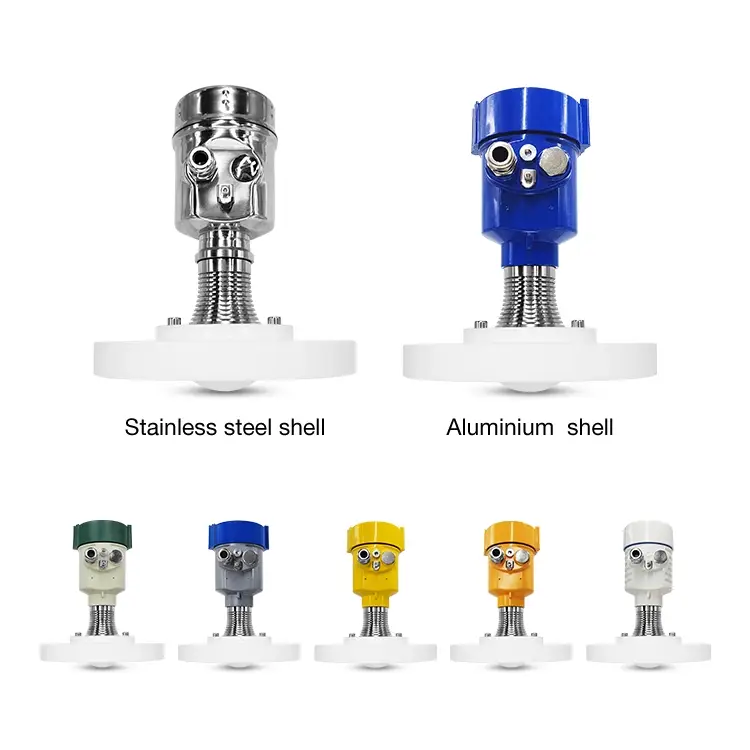
Unlike ultrasonic measurement, radar signals travel at approximately the speed of light and are generally much less dependent on the physical properties of the gas above the liquid.
Why choose radar for demanding applications?
The difference between radar level sensors and ultrasonic level sensors becomes particularly important when the process environment is difficult.
Radar level measurement is generally less affected by factors such as:
- Steam
- Vapor
- Dust
- Temperature changes in the gas space
- Atmospheric changes
- Certain types of surface disturbance
Modern radar level sensors can also provide high measurement resolution and accuracy, depending on the radar technology, antenna design, installation conditions, and application.
Advantages of radar level sensors
Typical advantages include:
- Non-contact measurement
- No moving parts
- Suitable for demanding industrial environments
- Less affected by steam and vapor than ultrasonic technology
- Better suitability for dusty environments
- Suitable for many corrosive liquids when appropriate antenna and materials are selected
- Long measurement ranges are available
- High measurement accuracy is possible
For applications where measurement reliability is more important than minimizing initial equipment cost, radar is often a strong candidate.
Limitations of radar level sensors
Radar is not completely immune to installation problems.
Potential challenges include:
- Reflections from tank internals
- Multiple echoes in tanks containing obstacles
- Antenna selection affecting measurement performance
- Installation position affecting signal quality
- More advanced configuration requirements for difficult applications
For example, agitators, heating coils, ladders, pipes, and other metal structures inside a tank can create unwanted reflections.
Proper antenna positioning, installation, and parameter configuration are therefore important for reliable measurement.
Best applications for radar level sensors
Radar is commonly considered for:
- Chemical storage tanks
- Oil and petroleum applications
- Industrial process vessels
- Large storage tanks
- High-temperature applications
- Enclosed or pressurized vessels
- Applications involving steam or vapor
- Applications requiring high measurement reliability
When comparing different liquid level sensor types, radar is particularly attractive when process conditions make ultrasonic measurement difficult.
4. Capacitive Level Sensor: Measuring Changes in Capacitance
A capacitive level sensor determines level by detecting changes in capacitance as the liquid or material level changes around the sensing probe.
Depending on the sensor design, capacitive technology can be used with different types of media, including conductive and non-conductive liquids.
It can also be considered for viscous materials, materials that tend to adhere to the probe, and certain corrosive media.
Advantages of capacitive level sensors
Depending on the specific design, capacitive level sensors can offer:
- Compatibility with conductive liquids
- Compatibility with non-conductive liquids
- Suitability for some viscous materials
- Suitability for materials prone to sticking
- Options for corrosive media with appropriate probe materials
- Suitability for applications with limited installation space
- Potential use in pharmaceutical and food applications where sealing and hygiene are important
- Availability for certain high-temperature and high-pressure applications
For aggressive chemical applications, a corrosion-resistant probe may be required.
Limitations of capacitive level sensors

Capacitive level measurement also has limitations that should be considered before selection:
- It is generally a contact-type measurement technology.
- Installation and maintenance can be more demanding because the probe is exposed to the medium.
- Compared with radar, it is generally more suitable for shorter measurement distances.
- Material buildup on the probe can affect measurement performance.
- The actual suitability depends strongly on the electrical properties of the measured medium and the sensor design.
For this reason, capacitive technology is often more appropriate for specific short-range applications than for large storage tanks requiring long-range measurement.
Radar vs Ultrasonic vs Submersible vs Capacitive
Now that we have examined the working principles, how do these four major liquid level sensor types compare?
| Factor | Ultrasonic | Radar | Submersible | Capacitive |
|---|---|---|---|---|
| Measurement principle | Sound waves | Electromagnetic waves | Hydrostatic pressure | Capacitance change |
| Contact with liquid | No | No | Yes | Usually yes |
| Foam | Can affect measurement | Generally less affected | Generally not a direct issue | Application-dependent |
| Steam/vapor | Can affect measurement | Generally less affected | Generally not a direct issue | Application-dependent |
| Dust | Can affect measurement | Generally better suited | Generally not a direct issue | Application-dependent |
| Deep measurement | Moderate to long range | Moderate to long range | Very suitable | Generally short range |
| Clean water | Excellent candidate | Suitable | Excellent candidate | Usually application-specific |
| Difficult industrial conditions | Limited in some applications | Strong candidate | Application-dependent | Application-dependent |
| Initial cost | Low to moderate | Higher | Low to moderate | Application-dependent |
The important point is that no technology wins in every category.
The right choice depends on the actual process.
Five Common Mistakes When Selecting a Liquid Level Sensor
Many level measurement problems are not caused by a defective sensor. They are caused by choosing a technology that does not match the application.
Here are five mistakes worth avoiding.
Mistake 1: Using Ultrasonic Sensors in Difficult Conditions
A non-contact sensor is not automatically suitable for every tank.
Heavy foam, steam, vapor, and turbulence can weaken or distort ultrasonic signals.
Possible results include:
- Unstable readings
- Signal loss
- Incorrect level values
- Reduced measurement distance
If these conditions are significant, radar should be evaluated as an alternative.
Mistake 2: Choosing the Highest Accuracy Without a Real Requirement
Higher accuracy does not necessarily mean a better solution.
A standard water tank used for routine monitoring may not require extremely high measurement accuracy.
In such applications, an ultrasonic or submersible level sensor may already provide sufficient performance.
Using a high-end radar sensor where it provides no meaningful process benefit can unnecessarily increase project costs.
The right approach is to match accuracy to the actual process requirement.
Mistake 3: Ignoring Installation Space
Installation conditions should be considered before purchasing a level sensor.
For top-mounted radar or ultrasonic measurement, check whether there is enough space for the sensor and its mounting connection.
Also consider:
- Tank nozzle dimensions
- Internal pipework
- Beams and ladders
- Agitators
- Heating coils
- Other internal obstacles
- Distance from the sensor to the maximum liquid level
- Required installation position
When top-mounted installation is impractical, another technology or installation method may be more appropriate.
Mistake 4: Selecting a Measurement Range Without Enough Margin
Do not select the measurement range based only on the normal operating level.
Consider the maximum possible liquid level, process fluctuations, installation distance, and sensor dead zone.
For many conventional applications, leaving approximately 20–30% additional measurement margin can provide useful operating room. However, the appropriate margin depends on the sensor and actual process conditions.
Mistake 5: Ignoring Temperature and Pressure
Temperature and pressure can significantly influence the choice of level measurement technology.
For example, ultrasonic measurement relies on sound propagation and can become more challenging when significant temperature gradients, vapor, or pressure are present.
For enclosed vessels with elevated pressure or extreme temperatures, radar is often a stronger non-contact candidate.
For shorter-range applications, capacitive technology may also be suitable if its temperature, pressure, material, and electrical specifications meet the process requirements.
How to Choose the Right Liquid Level Sensor Types for Your Application
Instead of comparing dozens of specifications, start with four basic questions.
Step 1: How Will the Sensor Be Installed?
First determine whether the sensor can contact the liquid.
Non-contact measurement
Consider:
- Radar level sensor
- Ultrasonic level sensor
Contact measurement
Consider:
- Submersible level sensor
- Capacitive level sensor
This first step can immediately eliminate several unsuitable options.
Step 2: What Is the Medium and What Are the Process Conditions?
The characteristics of the liquid and the environment are critical.
Steam, vapor, dust, or strong process disturbance
Radar is usually the first technology to evaluate.
Viscous or strongly corrosive media
Consider a properly designed capacitive level sensor with suitable probe and wetted materials.
Clean water in an open tank
Ultrasonic or submersible level sensors are often practical and economical choices.
Step 3: What Are the Temperature and Pressure Conditions?
Determine whether the vessel is:
- Open or enclosed
- Atmospheric or pressurized
- Normal temperature or high temperature
- Stable or subject to large temperature changes
For demanding temperature and pressure conditions, radar is often a strong candidate for non-contact measurement.
For shorter-range applications, capacitive technology may also be suitable when its specifications meet the process requirements.
Step 4: How Much Accuracy Do You Actually Need?
Finally, determine the actual accuracy requirement.
Basic level monitoring
A submersible level sensor may be sufficient for many water-level applications.
General industrial measurement
An ultrasonic level sensor can be an economical choice when the environment is suitable.
High-accuracy or demanding process measurement
A radar level sensor may be the better choice.
The goal is not to select the sensor with the highest specification.
The goal is to select the sensor that delivers the required performance under actual operating conditions.
Wondering What types of level sensor is the Right Solution For your Application?
Our engineers will recommend the most suitable model based on your specs and budget.
Which Liquid Level Sensor Is Best for Different Applications?
A simple application-based approach can make the selection process much easier.
For clean-water tanks
Consider:
Ultrasonic or submersible level sensors
They can provide economical and practical solutions for many conventional water-level applications.
For deep wells and reservoirs
Consider:
Submersible level sensors
Hydrostatic measurement is particularly practical when the sensor can be installed below the liquid surface.
For steam, vapor, or dusty environments
Consider:
Radar level sensors
Radar is generally less affected by these environmental conditions than ultrasonic technology.
For high-temperature or pressurized vessels
Consider:
Radar or application-specific capacitive level sensors
The final selection should be based on the actual temperature, pressure, material compatibility, and measurement range.
For short-range applications with viscous or challenging media
Consider:
Capacitive level sensors
The probe design and material compatibility should be checked carefully.
More Liquid Level Sensor Types You Should Know
The four technologies discussed above—ultrasonic, radar, submersible, and capacitive level sensors—are among the commonly used solutions for liquid level measurement.
However, they are far from the only options.
Other important liquid level sensor types include:
- Glass tube level gauges
- Magnetic level gauges
- Differential pressure level transmitters
- Float level switches and float level sensors
- RF admittance level sensors
- Magnetostrictive level sensors
- Servo level gauges
These technologies use different measurement principles and are designed for different applications.
For example, a magnetic level gauge provides direct visual indication, a differential pressure transmitter determines level from pressure difference, and magnetostrictive technology can provide highly precise point or continuous level measurement depending on the application.
Each technology has its own advantages, limitations, installation requirements, and suitable process conditions.
In the next article, we will take a closer look at these additional liquid level sensor types, explaining how they work, where they are used, and how to select the right technology for different industrial applications.
Final Takeaway: The Best Level Sensor Is the Right One for Your Process
When evaluating liquid level sensor types, there is no universal winner.
The most expensive sensor is not necessarily the best solution, and the cheapest sensor is not necessarily the most economical choice in the long term.
Instead, start with the actual application.
Ask:
- What is the measured liquid?
- Can the sensor contact the liquid?
- What is the measurement range?
- What are the temperature and pressure conditions?
- Is there foam, steam, vapor, dust, or turbulence?
- How much measurement accuracy is actually required?
- What installation space is available?
For clean and stable water applications, ultrasonic or submersible measurement may be sufficient.
For difficult industrial environments, radar can provide a more suitable non-contact solution.
For specific short-range applications, capacitive technology may offer advantages that radar and ultrasonic sensors do not.
Ultimately, successful level measurement is not about choosing the sensor with the most impressive specifications.
It is about matching the measurement principle to the real process conditions.
If you are unsure which of the available liquid level sensor types is suitable for your application, providing the medium, measurement range, temperature, pressure, tank dimensions, and installation conditions is usually the best starting point for selecting the right technology.