For automation engineers, instrumentation engineers, and process selection specialists, there is a common problem that often appears only after an electromagnetic flowmeter has been installed for several months.
The flowmeter was selected according to the basic process parameters. The pipe size is correct, the measuring range looks suitable, and the output signal works normally during commissioning.
Then, after several months in the field, problems begin to appear:
- Unstable or jumping flow readings
- Measurement drift
- Liner blistering or peeling
- Liner deformation
- Leakage around the measuring tube
- Increasing maintenance frequency
- Premature flowmeter failure
The first reaction is often: “The flowmeter quality is not good enough.”
But in many real-world applications, the problem is not the electronics or measuring principle. The liner material may simply be incompatible with the actual process conditions.
The liner is one of the most important components of an electromagnetic flowmeter. It provides electrical insulation between the conductive process liquid and the measuring tube while also protecting the meter from corrosion, temperature, pressure conditions, and mechanical wear.
Among the most commonly used liner materials are rubber, PTFE (polytetrafluoroethylene), and F46 (FEP).
They may look similar from the outside, but their performance can be significantly different.
This guide explains the practical differences between these three materials and helps you determine when rubber is sufficient, when PTFE is the better choice, and when F46 is worth the additional cost.
Why Electromagnetic Flowmeter Liner Selection Matters
An electromagnetic flowmeter measures the velocity of a conductive liquid using electromagnetic induction. The electrodes detect the voltage generated as the conductive fluid moves through the magnetic field.
For this measurement principle to work correctly, the process liquid must remain electrically isolated from the metal measuring tube except through the measuring electrodes.

That is why the liner is so important.
A suitable liner needs to withstand the actual:
- Chemical composition of the medium
- Operating temperature
- Pressure and vacuum conditions
- Abrasion and particle loading
- Concentration of corrosive chemicals
- Long-term process conditions
If the liner deteriorates, the problem can eventually affect measurement stability and the service life of the entire electromagnetic flowmeter.
A simple rule for selecting a liner
Do not select a liner based only on the name of the medium.
For example, “acid” is not enough information.
You should also consider:
- Acid concentration
- Operating temperature
- Flow velocity
- Pressure
- Possible negative pressure
- Presence of solids or particles
- Whether the medium is volatile or permeable
- Whether the process temperature changes frequently
The same chemical can require different liner materials under different operating conditions.
01. Rubber Liner: The Cost-Effective Choice for Water and General Applications

Rubber is one of the most widely used liner materials for electromagnetic flowmeters.
Depending on the application, different rubber formulations may be used, including hard rubber and soft rubber.
Its biggest advantages are good flexibility, mechanical resilience, wear resistance in many water applications, and relatively low cost.
Key Advantages of Rubber Liners
1. Good resistance to mechanical stress
Rubber is flexible and resilient. When properly selected and installed, it can tolerate certain pressure fluctuations and mechanical impacts better than relatively rigid liner materials.
This makes rubber attractive for water and wastewater applications where the process conditions are not highly corrosive.
2. Good resistance to wear in suitable applications
Soft rubber can provide a degree of elastic cushioning against water flow containing moderate amounts of suspended particles.
For some wastewater and water-treatment applications, this can make rubber a practical choice.
However, the actual abrasion resistance depends strongly on the rubber formulation, particle concentration, particle size, and flow velocity.
3. Excellent cost performance
For non-corrosive or mildly aggressive liquids, there is often no economic reason to choose a high-end fluoropolymer liner.
Rubber is commonly suitable for applications such as:
- Municipal water supply
- Wastewater
- Cooling water
- Industrial circulating water
- Rainwater systems
- General process water
Limitations of Rubber Liners
The main limitation of rubber is its chemical and temperature resistance.
Rubber should not be selected simply because it is inexpensive.
Depending on the specific rubber compound, exposure to aggressive chemicals or excessive temperature can cause:
- Swelling
- Softening
- Cracking
- Loss of mechanical strength
- Premature liner failure
Therefore, rubber is generally not the first choice for strongly corrosive chemicals, organic solvents, or high-temperature process media.
When should you choose rubber?
Rubber is usually a good starting point when the process is:
- Water-based
- Non-corrosive or mildly aggressive
- Relatively low temperature
- Not highly solvent-based
- Not subject to severe chemical attack
Typical applications: municipal wastewater, water supply, cooling-water systems, and general industrial water.
02. PTFE Liner: The Versatile Choice for Corrosive Chemical Media
PTFE, or polytetrafluoroethylene, is one of the most important fluoropolymer liner materials used in electromagnetic flowmeters.

Its biggest advantage is excellent chemical resistance.
Compared with conventional rubber liners, PTFE can handle a much wider range of chemically aggressive process media.
Key Advantages of PTFE Liners
1. Excellent chemical resistance
PTFE is highly resistant to many acids, alkalis, solvents, and aggressive chemical solutions.
This makes it a common choice for:
- Chemical processing
- Electroplating
- Pharmaceutical processes
- Corrosive industrial wastewater
- Chemical solutions
- Certain food and slurry applications
However, “PTFE is chemically resistant” does not mean it is universally compatible with every chemical at every temperature and concentration.
The final selection should always be checked against the actual chemical composition and operating conditions.
2. Wider temperature capability than many rubber liners
PTFE generally provides much better temperature resistance than conventional rubber.
For many electromagnetic flowmeter applications, PTFE is selected when the process temperature is beyond the practical range of common rubber liners.
The actual allowable temperature, however, depends on the specific flowmeter construction, pressure, liner design, flange configuration, and manufacturer specifications.
3. Smooth, low-friction surface
PTFE has a smooth surface and a low coefficient of friction.
This can help reduce the tendency of some materials to adhere to the liner surface.
For fluids where deposits can interfere with electrode performance, the appropriate PTFE liner can therefore be advantageous.
The Most Important Limitation of PTFE: Vacuum Conditions
One of the most important considerations when selecting PTFE is negative pressure or vacuum service.
PTFE is relatively flexible compared with some other liner materials. Under unsuitable vacuum conditions, the liner can deform or become detached from the measuring tube.
Possible consequences include:
- Liner deformation
- Blistering
- Separation
- Measurement instability
- Permanent damage to the flowmeter
This is particularly important in pipelines where pumps stop suddenly, valves close rapidly, or the pipe may experience vacuum conditions.
Therefore, chemical compatibility alone is not enough to justify selecting PTFE.
The pressure and vacuum conditions must also be checked.
PTFE and Abrasion
PTFE is excellent for chemical resistance, but it is not automatically the best choice for highly abrasive fluids.
For media containing:
- Large quantities of sand
- Hard particles
- High concentrations of solids
- Highly abrasive slurry
The liner selection should consider actual particle size, concentration, velocity, and manufacturer recommendations.
When should you choose PTFE?
PTFE is often a strong choice when you need:
- High chemical resistance
- Good temperature resistance
- A smooth liner surface
- Compatibility with aggressive chemical media
- A proven solution for general chemical-process applications
But if the application combines high temperature + corrosive chemicals + vacuum risk + long service-life requirements, it may be worth considering a higher-performance fluoropolymer solution such as F46.
03. F46 Liner: When Standard PTFE Is Not Enough
One of the most common misunderstandings in electromagnetic flowmeter selection is treating PTFE and F46 as interchangeable simply because both belong to the fluoropolymer family.
They are not identical materials.
F46 is commonly used to refer to FEP (fluorinated ethylene propylene), a fluoropolymer with different processing and performance characteristics from PTFE.
For demanding chemical applications, F46 can be considered when the application requires a combination of chemical resistance, temperature capability, liner processing characteristics, and long-term stability.
Four Reasons to Consider F46
1. Lower permeability can matter in demanding applications
One important consideration with fluoropolymer liners is permeability.
Certain chemicals, particularly volatile or easily permeating substances, can create long-term challenges for liner performance.
F46 can offer favorable permeability characteristics in some applications, making it attractive for demanding chemical services.
However, permeability depends on the actual chemical, temperature, concentration, liner thickness, and construction.
So F46 should not be treated as a universal solution.
2. Suitable for demanding temperature applications
F46 can be considered for higher-temperature process applications where the selected flowmeter design and specific liner specification allow it.
For example, some demanding chemical processes may combine:
- Elevated temperature
- Corrosive liquids
- Long operating periods
- Strict requirements for measurement stability
In these cases, a higher-performance liner may provide a better overall engineering solution than selecting purely on initial purchase price.
Always use the manufacturer’s specified maximum operating temperature for the actual flowmeter model rather than applying a generic material temperature limit.
3. Better liner processing and adhesion can be valuable
Liner manufacturing technology has a major effect on actual flowmeter performance.
A properly processed fluoropolymer liner needs to maintain good contact with the measuring tube and withstand the actual pressure conditions.
This is why engineers should evaluate not only the liner material but also:
- Liner thickness
- Liner forming method
- Bonding or fixation method
- Measuring tube construction
- Flange design
- Pressure rating
- Vacuum resistance
Material selection and manufacturing quality should be considered together.
4. Long-term stability
For applications where downtime is expensive, the lowest initial price is not always the lowest total cost.
A suitable high-performance liner can help reduce the risk of premature replacement and maintenance when the process is genuinely demanding.
This is especially relevant for continuous chemical production lines where unexpected flowmeter downtime can affect the entire process.
When Is F46 Worth the Extra Cost?
A useful way to think about F46 selection is to ask:
What failure mode am I trying to prevent?
If the main problem is chemical attack, PTFE may already provide sufficient protection.
If the application combines multiple challenges, such as:
- High process temperature
- Aggressive chemicals
- Volatile or permeable media
- Pressure fluctuations
- Potential vacuum conditions
- Continuous operation
- High cost of unplanned maintenance
Then a higher-performance liner specification may make more sense.
F46 may be worth considering for:
High-temperature corrosive liquids
When process temperature is beyond the practical range of the selected rubber or standard liner design, a suitable fluoropolymer liner may be required.
Volatile chemical media
For certain volatile or permeating chemicals, liner permeability becomes a more important selection factor.
Chemical pipelines with pressure fluctuations
If the pipeline can experience pressure changes or vacuum conditions, liner construction and vacuum resistance should be evaluated carefully.
Long-term continuous measurement
For critical process measurement points where reliability and maintenance intervals are more important than the lowest initial price, a premium liner may provide better lifecycle value.
When F46 Is Simply Overkill
Not every application needs the most expensive liner.
For example, if the process is:
- Clean water
- Cooling water
- Municipal wastewater
- Mild industrial wastewater
- Moderate-temperature non-corrosive liquid
then choosing F46 simply because it is a premium material may not provide a meaningful benefit.
In these situations, a properly selected rubber liner may offer a much better cost-performance ratio.
Likewise, if PTFE already satisfies the chemical, temperature, pressure, and mechanical requirements, upgrading to F46 may not be necessary.
Good engineering is not about choosing the most expensive material. It is about choosing the material that matches the actual process conditions.
A Practical Electromagnetic Flowmeter Liner Selection Process
Before asking an electromagnetic flowmeter supplier for a quotation, prepare the following information.
Step 1: Identify the Process Medium
Do not provide only a general name such as “chemical liquid.”
Provide:
- Exact medium name
- Chemical composition
- Concentration
- pH value, if relevant
Step 2: Confirm Temperature
Provide both:
- Normal operating temperature
- Maximum/minimum temperature
Temperature can significantly affect liner performance and chemical compatibility.
Step 3: Check Pressure and Vacuum Conditions
Provide:
- Normal operating pressure
- Maximum pressure
- Possible negative pressure
This step is particularly important for PTFE-lined flowmeters.
Step 4: Evaluate Abrasion
If the liquid contains sand, sludge, crystals, or other solid particles, provide:
- Solid concentration
- Particle size
- Flow velocity
- Whether the particles are hard or soft
Chemical resistance alone does not determine liner life.
Step 5: Consider the Cost of Failure
For a low-cost water application, optimizing the purchase price may be reasonable.
For a critical chemical production line, however, the cost of an unexpected shutdown can be much higher than the price difference between two liner options.
This is where a more conservative liner selection can make economic sense.
The Most Common Liner Selection Mistakes
Mistake 1: Choosing the cheapest liner
The lowest purchase price does not necessarily mean the lowest total cost.
A failed liner can mean:
- Flowmeter replacement
- Production downtime
- Installation labor
- Recalibration
- Emergency maintenance
Mistake 2: Selecting based only on chemical name
“Sulfuric acid,” “hydrochloric acid,” or “solvent” is not enough information.
Concentration and temperature can dramatically change material compatibility.
Mistake 3: Ignoring negative pressure
This is one of the most serious mistakes in PTFE-lined electromagnetic flowmeter applications.
Always check whether the pipeline can experience vacuum conditions.
Mistake 4: Assuming F46 is always better
A premium material is only useful when its additional properties solve a real process problem.
For ordinary water applications, F46 may provide little practical benefit.
Mistake 5: Ignoring the complete flowmeter design
The liner is only one part of the system.
The actual performance also depends on:
- Electrode material
- Measuring tube material
- Connection design
- Liner construction
- Grounding
- Installation conditions
- Converter configuration
A good electromagnetic flowmeter supplier should evaluate the complete application rather than simply asking, “Which liner do you want?”
How an Experienced Electromagnetic Flowmeter Supplier Should Help
When selecting an electromagnetic flowmeter, the supplier should not simply provide a price based on DN size.
A professional supplier should first understand the process.
At minimum, provide:
- Medium
- Pipe diameter
- Flow range
- Operating temperature
- Operating pressure
- Possible vacuum conditions
- Medium conductivity
- Chemical concentration
- Suspended solids or particles
- Required output and communication
- Process connection
- Installation environment
Based on these parameters, the supplier can recommend an appropriate combination of:
Liner + electrode material + measuring tube + converter + connection + protection class.
This approach is much more reliable than selecting the flowmeter based on price alone.
Common Electromagnetic Flow Meter Types and Their Applications
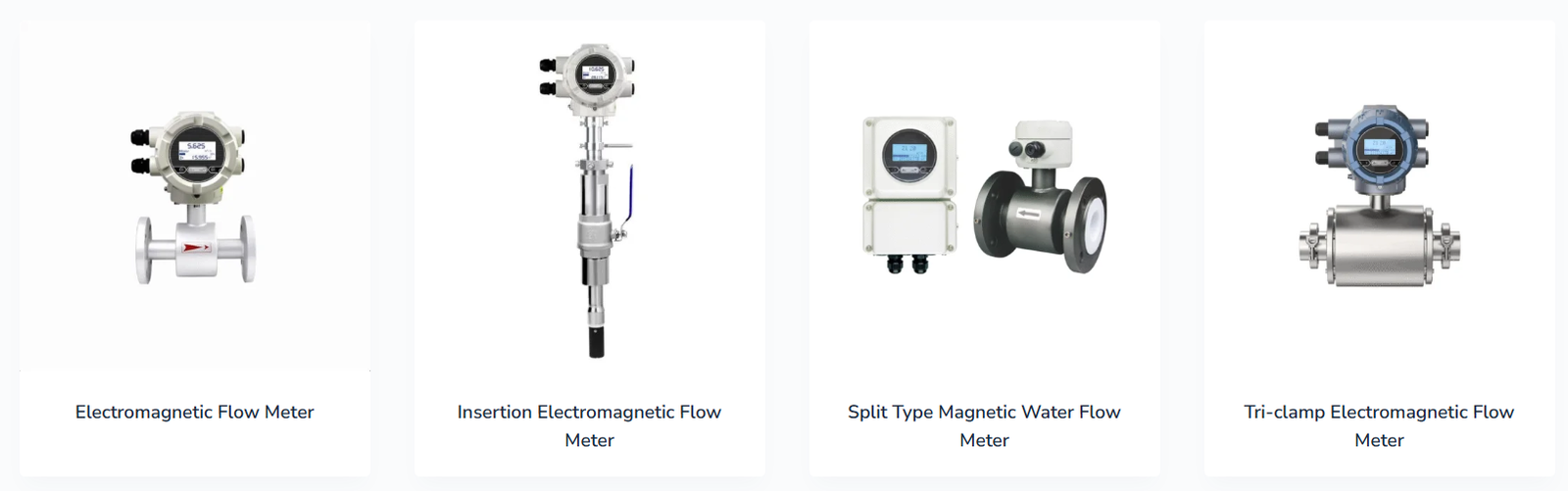
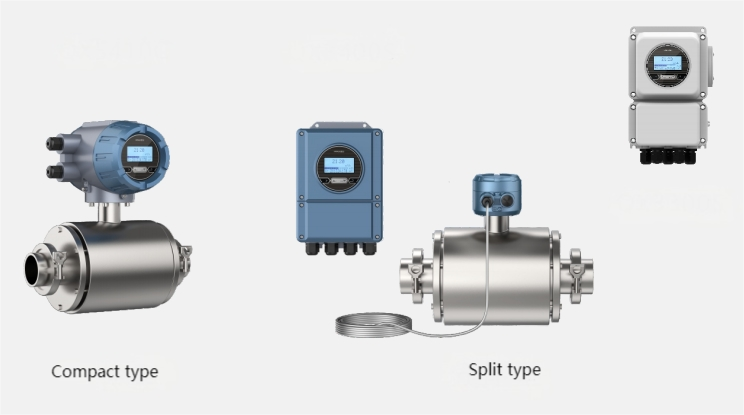
Electromagnetic flowmeters are available in several configurations to suit different installation environments and process requirements. Choosing the right electromagnetic flow meter type is just as important as selecting the correct liner material.
The most common types include flanged electromagnetic flowmeters, wafer-type electromagnetic flowmeters, threaded electromagnetic flowmeters, sanitary electromagnetic flowmeters, and insertion electromagnetic flowmeters.
1. Flanged Electromagnetic Flowmeter
Flanged electromagnetic flowmeters are one of the most widely used types for industrial applications.
They are installed between pipe flanges and provide a robust connection suitable for a wide range of pipe sizes and operating conditions.
Typical applications include:
- Municipal water supply
- Wastewater treatment
- Industrial process water
- Chemical processing
- Mining and slurry applications
- Large-diameter pipelines
Flanged electromagnetic flowmeters are particularly suitable when reliable installation and long-term operation are more important than compact size.
2. Wafer-Type Electromagnetic Flowmeter
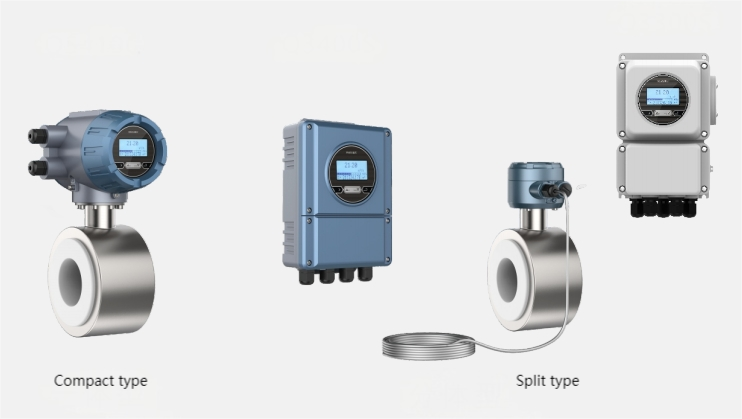
A wafer electromagnetic flowmeter is installed between existing pipe flanges without using an extended flanged body.
Its compact design can help reduce installation space and overall equipment weight.
Typical applications include:
- Water treatment
- HVAC systems
- Industrial circulating water
- General process applications
- Small and medium-sized pipelines
For applications where space is limited, a wafer-type design can be a practical alternative to a conventional flanged flowmeter.
3. Threaded Electromagnetic Flowmeter
Threaded electromagnetic flowmeters are generally designed for smaller pipe sizes and relatively compact installations.
They are often used where the pipeline connection is threaded rather than flanged.
Typical applications include:
- Small industrial equipment
- Water treatment equipment
- Dosing systems
- OEM machinery
- Laboratory and process equipment
4. Sanitary Electromagnetic Flowmeter
Sanitary electromagnetic flowmeters are designed for applications where hygiene and cleanability are critical.
They may use sanitary connections such as tri-clamp connections and are commonly selected for industries with strict hygiene requirements.
Typical applications include:
- Food and beverage
- Pharmaceutical production
- Biotechnology
- Dairy processing
- Pure-water systems
In these applications, the wetted materials and internal surface design need to meet the requirements of the specific process.
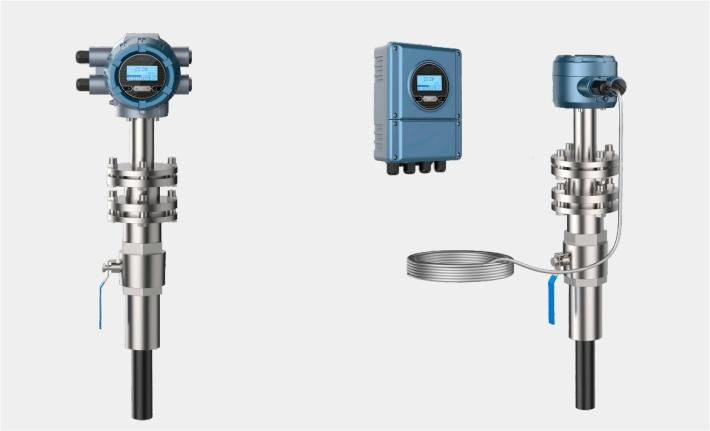
5. Insertion Electromagnetic Flowmeter
Insertion electromagnetic flowmeters are installed through an opening in the existing pipeline rather than replacing the entire pipe section.
They can be particularly useful for:
- Large-diameter pipelines
- Existing water networks
- Water distribution systems
- Cooling-water systems
- Applications where full-pipe replacement is impractical
However, installation conditions and flow profile requirements need to be carefully evaluated to achieve reliable measurement.